
Tomy Atomic Pinball
A quick note on repairs...
I don't know of anyone (including me) who repairs these games or has spare parts. The games are just toys and probably not meant to be serviced. This webpage exists only because I like to take stuff apart. If your game is broke you have nothing to lose by taking it apart and tinkering. But I have no advice beyond what you already see on this page. The most common problems appear to be missing legs and missing balls. The height and shape of a leg are shown below. The remaining dimensions can be ascertained from the leg sockets on the bottom of the game. Replacements could be fashioned from wood blocks or other suitable material (3D printed legs and other parts are also available). The balls are just 9⁄16" steel balls. Pinball parts supply businesses usually sell odd size pinballs including 9⁄16" balls. If you can't fix your game, replacement games can still be had on eBay for not much money. Good Luck!
Exception: I do have extra motor pinion gears. See below.

Here's a leg with a ruler for scale.
More About Legs
Bryan emailed me this .stl file to 3D print your own replacement legs. You can download the file via the following link. Disclaimer: I know nothing about 3D printing and have in no way verified the contents of the file. Here's the link... leg3dprinter.stl.
Legs and other parts are becoming increasingly available via 3D printing technology. Check sites like Thingiverse, Shapeways or even eBay.
Excessive Gear Noise
People have complained that these games are loud and noisy. Yes they are. With all those gears and other moving parts it's just the nature of what it is. I don't recommend lubrication since it's difficult to know how the different plastics may react. Plus lubricants may gum up in the long run and do more harm than good.
On to the game...
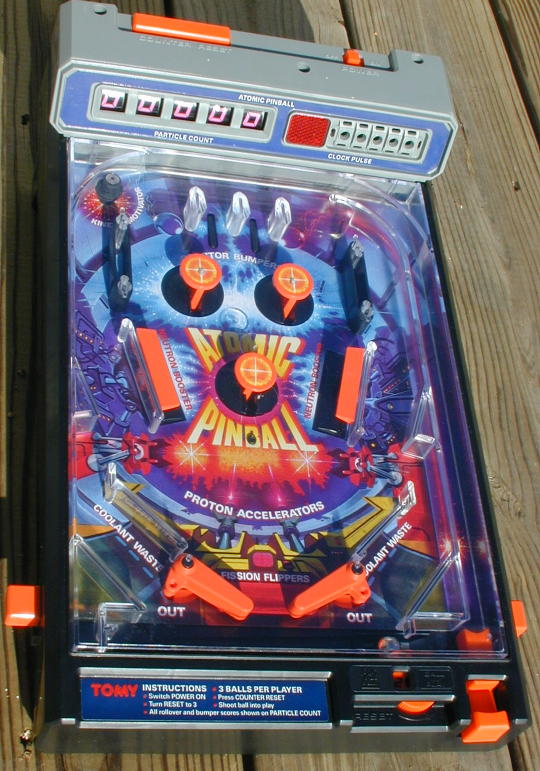
Here's my Tomy Atomic Pinball game. I had one of these games when I was a kid. I believe the game was originally introduced in 1979 and is still available today (as of 2006). Every now and again I'd see one of these games at a yard sale or swap meet and get to feeling nostalgic about it. So I finally bought me a new one. My new Atomic Pinball shown here is not exactly like the one I had in 1979. The original was called Atomic Arcade Pinball. The body and head were both molded in white plastic and it had different playfield artwork. Even when I was a kid I knew enough about pinball to reject crappy toy pinball machines with their passive springs and rubber bands. But Atomic Pinball is different. This game has reactive bumpers and slingshots just like the real thing! The center playfield features three bumpers and two slingshots (the slingshots are more like rectangular bumpers, but they most closely mimic slingshots on the real thing, so that's what I'll call them). Each bumper or slingshot hit scores a point. There are also two top rollovers that score a point. The three rightmost score reels are actually one reel. So ignoring the two least significant digits, the game scores from 000 to 999. The two orbits are pretty useless and are more likely to lead to outlane drains than points. The best shots are straight up either side of the bumper nest to the top of the playfield and the rollovers. Getting the ball back down the shooter lane is also possible. The game makes an electronic dinging sound with each point scored and has a blinking red light on the head that just blinks at a constant rate and has no other purpose. As explained below, the game is driven by a motor and gear arrangement that is really quite noisy when running. The game requires 4 "D" batteries (original games required 5 "D" batteries). Starting a new game involves turning on the power, resetting the score reels and resetting the ball counter to "3". When the ball counter reaches "0" the ball cannot be reloaded to the shooter lane.

Instruction manual for Atomic Pinball. Click for larger image.
Alternate Versions
The left picture below is of an original Atomic Arcade Pinball with white body and original artwork. Atomic Pinball was also offered with an outer space theme called "Starcom" as shown at right. I believe this version was available in the mid-1980s. The Starcom game seems rare and may have something to do with a broader line of toy action figures called "Starcom".

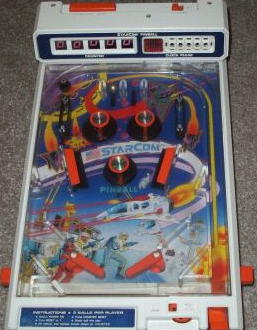
Original Atomic Arcade Pinball and Starcom.

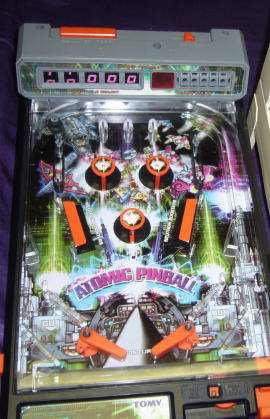
More art variations. Right image courtesy of Dalibor C.
The Guts
What's great about Atomic Pinball is that it's as much fun to take apart as it is to play. Imagine you're a ten-year-old with screwdriver in hand staring at all those gears and moving parts! This was defiantly one of my all-time favorite toys. Disassembly begins with the removal of three screws that hold the head cover to the body. With the head cover removed the "glass" lifts out. The sheet metal playfield is held down by a single black screw below the lower bumper. This screw can and should be discarded. The playfield stays in place without it and the screw just gets in the way of ball flow. There's an electric motor under the white cover on the right. The motor drives the horizontal shaft with all the red and blue parts. Then on the left there is a 90 degree transmission and a vertical shaft leading up to the score reels. Each of the five reactive parts has a black skirt around it. The ball hitting the skirt is what triggers the action. The two top rollover lanes trip the top left bumper to score the rollover points.

Head cover and playfield removed.
You can see a white plate underneath everything else. When one of the reactive parts is triggered it presses down on the white plate for scoring. The white plate closes a switch contact on the right which makes an electronic "ding" sound. The white plate also trips the transmission clutch on the far left which turns the score reel shaft and advances the score.

Bumper nest.
Now here's a close-up of the top right bumper. Note how the bumper (orange part) has a U-shaped appendage that loops under the red gear and has a rack gear on its end. Looking down the main drive shaft from right to left, the shaft turns clockwise. The red gear is fixed to the shaft and is always turning. The red gear turns the little white gear. The little white gear is mounted on the blue disk. The blue disk is held by a tab that engages the black skirt. When the ball hits the black skirt the blue disk is released and turns with the shaft. It hits the scoring plate on the way around and then the white gear engages the orange rack gear and pulls down the bumper which kicks the ball away. This is all more complicated than a real pinball machine which just uses a switch on the skirt and a solenoid to propel the bumper.
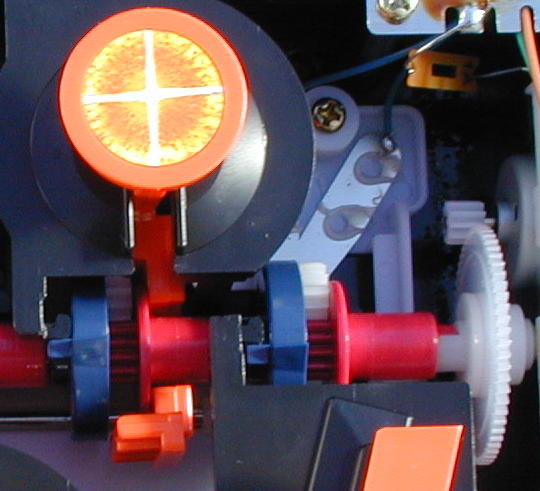
Bumper close-up.
The left picture below shows the 90 degree transmission for powering the score reels. Note the spring-loaded clutch. The small gear is not fixed to the main shaft. But the spring creates friction between the gear and the fixed hub on the end of the shaft. The large gear has a tab that engages the scoring plate. The tab holds both gears motionless. But when the score plate is depressed, the tab is released and the large gear is allowed to turn one revolution, which adds one point to the score. The right picture shows the motor cover removed. Refer to the pictures above and note the orange and green wires that lead to switch contacts on the underside of the cover. This switch is responsible for blinking the red light in conjunction with the worm gear and cam arrangement. Red arrows show the three cams that open and close the switch as the gear revolves. What intrigues me about this mechanism is the level of engineering and material that was invested into something as trivial as a blinking light that is completely inconsequential to game play. It's as if this entire pinball machine were designed as an academic exercise in mechanical engineering. It just begs to be taken apart and explored.
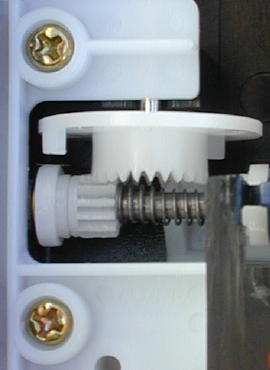

Shaft details.

Component side of the tone generator circuit board.

Solder side of the tone generator circuit board.
Patent Drawings

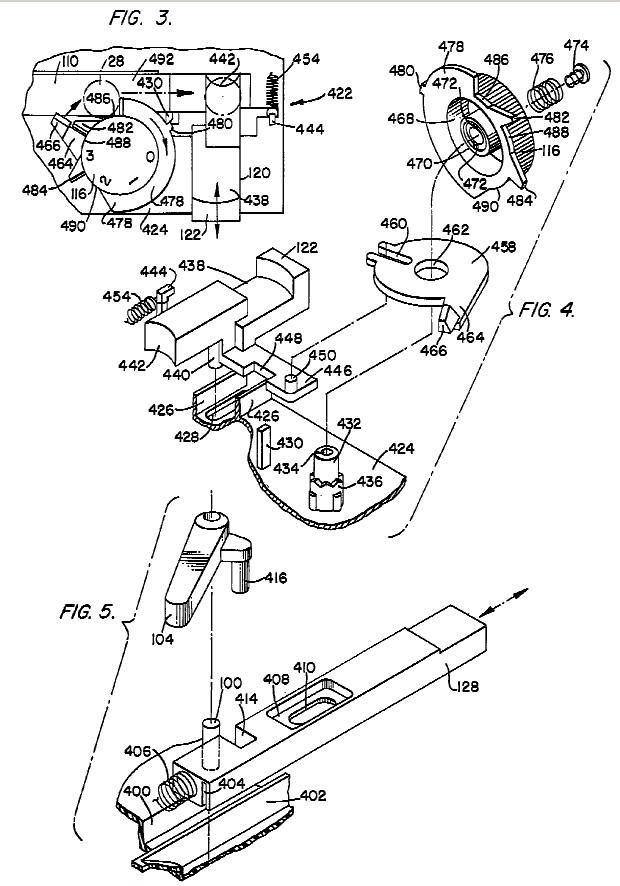


Patent drawings for Atomic Arcade Pinball. Click drawing for larger image.
In the patent drawings above, note the odd series/parallel arrangement of five batteries. The tone generator ran on 4.5 volts whereas everything else ran on 3 volts. New Atomic Pinball games use four batteries and everything runs on 3 volts. The image below shows the five-battery battery compartment from an older (original design?) Atomic Arcade Pinball.

Five-battery battery compartment. Image courtesy of David Callaghan.
Motor Pinion Repair
My game stopped working because the pinion gear slipped off the motor shaft. My first idea was to use the serrated jaws of a vice grip pliers to press some "tooth" into the motor shaft. Then I realized that the pinion gear itself had split. So I scrapped the old gear and pressed on a new one. But the new gears I had were slightly larger and ran too tight against the big spur gear. I modified the game by using a sharp chisel to carefully enlarge the motor mount. Now the motor slightly floats in its mount and the gears run great. In fact, the game runs more free and quiet than it did with the old gear. Loosening up the motor mount turned out to be a great idea.
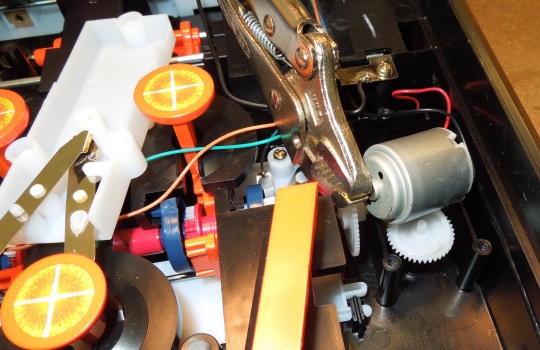
Adding some "tooth" to the motor shaft.

New pinion gears compared to the old (white) gear.

Using a sharp chisel to enlarge the motor mount. The game actually runs more freely now that the motor slightly floats in the mount.

Pinion gear and motor reinstalled.
I don't remember where I got the orange gears, but they weren't quite the right size anyway. Cracked gears must be a common problem because I've since given away all my extra orange gears. I took another look at the original pinion gear and it looks to be a 10 tooth with an outer diameter of 6 mm, a thickness of 5 mm and a shaft diameter of 2 mm. The thickness dimension isn't all that critical. I also so took another look on the Internet and gears now seem to be a lot easier to find. I even found what appeared to be a suitable replacement on Amazon. Try a search for "Uxcell a14031300ux0098".
Update: I tried a package of those Uxcell gears and they appear to be identical to the original. The motor mount modification noted above would probably not be required. If you live in the United States and want a gear, shoot me an email.
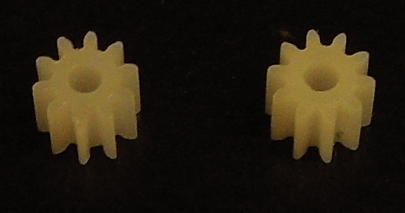
Uxcell pinion gear (left) compared to the original.
Adding an AC Power Pack (Not Really)
I added a jack to the game and attempted to power it from an AC power pack in lieu of batteries. The game requires four D batteries so you might think you need a 6 volt power supply. Not true. The game (or at least my game) employs two independent 3 volt circuits. One pair of batteries powers the motor. The other pair of batteries powers the blinking light and circuit board for the sound effect. Even the power switch is a double pole switch to maintain isolation between the two circuits. I connected the two circuits in parallel and attempted to power them both with a 3 volt, 700 milliamp power pack. It didn't work. The pack was powerful enough to run the motor, but not powerful enough to start the motor. I gave up. But if you decide to try this for yourself, you'll need a power pack that can output more than 700 milliamps. I think it would work with a more powerful pack.
Rubber Modifications
The game's playfield includes two black rubbers that don't provide much bounce. The tiny light-weight pinball just doesn't carry enough momentum to interact well with the stock rubber. I replaced the rubbers with Scunci hair bands which are made from a much bouncier form of rubber. I used seven hair bands at each of the two positions. So it takes one package of hair bands to outfit the game. The bouncier rubber conveys a much more realistic movement to the little pinball and the game is correspondingly more fun.
For whatever reason, this particular Scunci product seems hard to find. I found mine at a CVS Pharmacy. At rest the bands are about 1 1⁄8" in diameter and about 3⁄32" thick. They are packaged as all black or half black, half clear. I prefer all black.

Scunci hair bands.
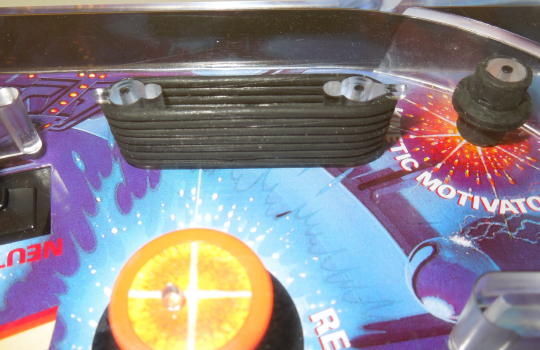
Scunci hair bands installed.
Other Toys with Atomic Mechanisms
Note: All the games shown below appear to be exceptionally rare. It's interesting that so many companies put so much time and expense into "reinventing" Atomic Pinball for what all appear to be very low production runs.
Here's a game called Electronic Thunder Ball Stunt Jumper. The name Playwell is molded into the back of the case, but there's no apparent reference to Tomy. Nevertheless, the toy employs the basic Tomy Atomic Pinball mechanisms. Compared to Atomic Pinball, the enclosure is different. The power light stays ON when the game is ON. There's no mechanical blinking light mechanism. Instead of a single sound effect, this game has many individual feature switches and more wiring and electronics for a wider variety of sound effects. The coolest feature of this game is a yellow LED in each of the three bumpers. Each LED flashes with each respective bumper hit. Game play is identical to Atomic Pinball. Stunt Jumper appears to be a pretty rare toy.
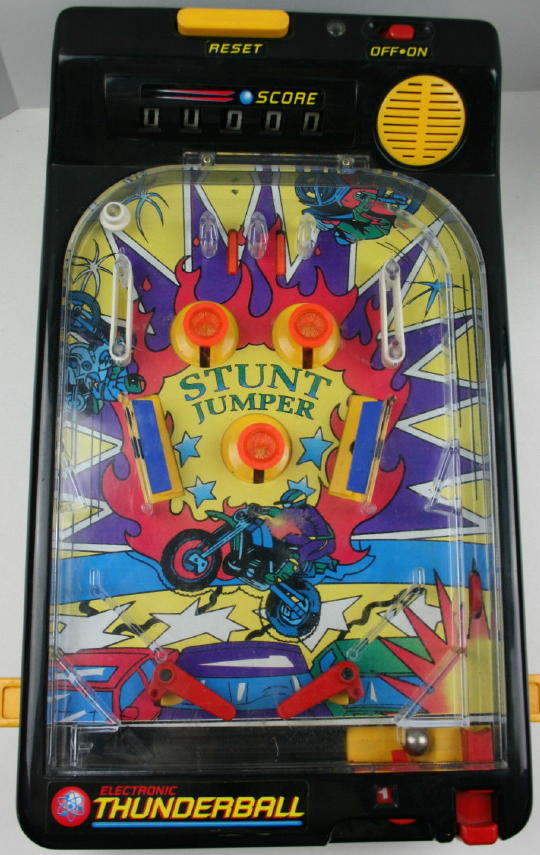
Electronic Thunder Ball Stunt Jumper.

Disassembly is completely different from Atomic Pinball. Note all the extra wiring for the various sound effects switches and bumper LEDs.
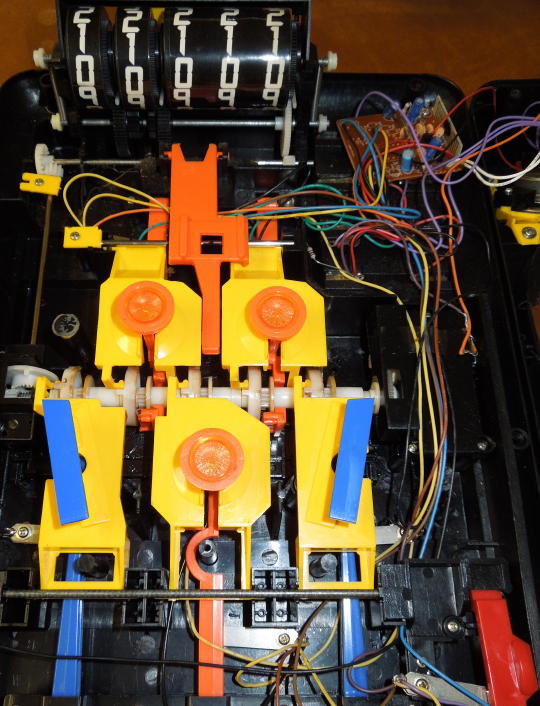
A closer shot of the mechanisms.

A side view of a yellow LED in a bumper.
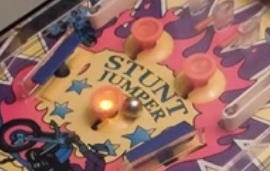
--EXTERNAL LINK-- Click image to go to a brief Stunt Jumper YouTube video. The LEDs are a bit more impressive than the video depicts, but you get the idea.
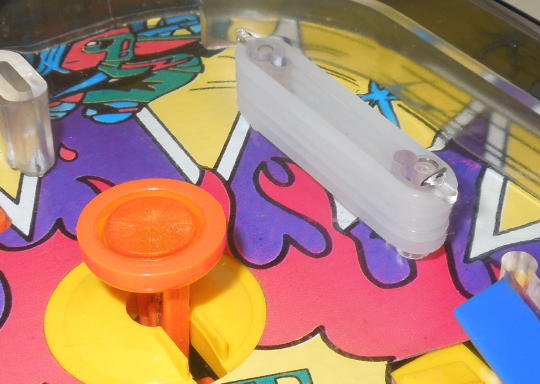
Here's the game set up with the Scunci hair bands as was discussed further up this page. In this case I used the clear bands and installed five per side.
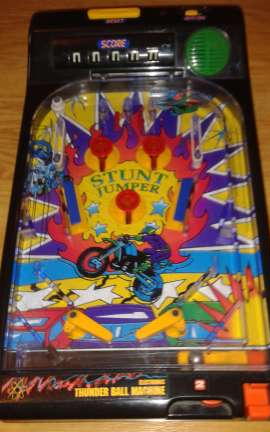

Two alternate versions of Electronic Thunder Ball Stunt Jumper.
Here's ATOMPINBALL. At first glance this may look like just another art re-theme. But there are a number of physical differences compared to the original Tomy Atomic Pinball. The enclosure is slightly larger even though everything within the enclosure is the same size as an Atomic. There's a small black ON/OFF switch for the sound effects which are more complex than Tomy Atomic. Atomic has no separate switch for the sound effects. The blinking red light is electronically driven so the game lacks the cam and switch mechanism found in Atomic.

An overview of ATOMPINBALL. Image courtesy of Matthias Steffen.

An upside down Tomy Atomic (left) compared to the slightly larger ATOMPINBALL. Image courtesy of Matthias Steffen.

CS Toys is molded into the underside battery cover with no reference to Tomy. Image courtesy of Matthias Steffen.
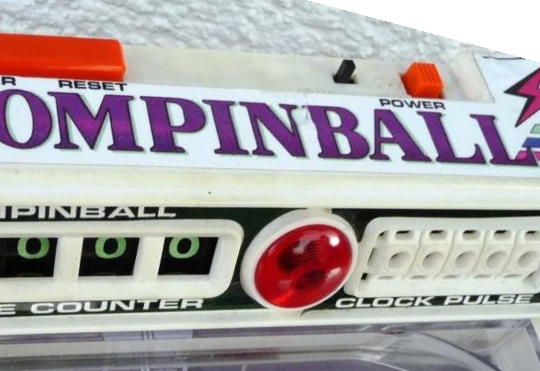
This game has a small black switch to turn the sound effects ON and OFF. The sounds are more complex compared to Tomy Atomic. Image courtesy of Matthias Steffen.
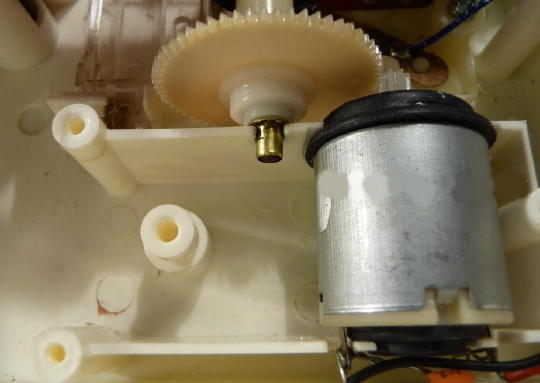
Here's an internal shot showing that the cam and switch mechanism for the blinking red light are missing. In this game the blinking red light is driven electronically. Image courtesy of Matthias Steffen.
This is Space War Atomic Pinball from Nordic Inc. The game has a red translucent cover over the score reels and an upper detachable sign. Otherwise the game appears to be a near clone of Tomy's Atomic Pinball.

Space War Atomic Pinball from Nordic Inc. What does a steam locomotive have to do with space wars? Image courtesy of Lee Stamberg.
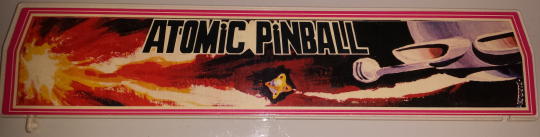
Detachable sign. Image courtesy of Lee Stamberg.

Box for Space War Atomic Pinball. Note that the playfield art is different from the actual game. Image courtesy of Lee Stamberg.
Scientific Toys produced toy pinball games with the infamous passive springs. Boring! Shown below is a Scientific Toys game with the same layout as their spring games. But in this version the five springs are replaced with five active bumpers employing the Atomic-style mechanisms.

Street Fighter from Scientific Toys. Image courtesy of Tom Clark.
The next game, Grand Prix Raceway, is interesting in that it's a scaled down replica of Atomic Pinball. All the parts (including the ball) are about half the size of Atomic and game play is about the same. Actually it's too small. None of the parts have enough mass and momentum to "feel" anything like real pinball. Nevertheless, it's an interesting exercise in miniaturization. Mechanically the game uses the same type of mechanisms as Atomic Pinball. But there are some simplifications. Whereas Atomic Pinball has five independently reactive components, Grand Prix Raceway has only two. The two top rollovers and two top bumpers are a single unit forming one reactive component. The bottom bumper and two slingshots are another single unit forming the other reactive component. The pinball is a 3⁄8" steel ball. As noted at the top of this page, replacement balls might be obtainable from pinball and arcade parts supply businesses.

Grand Prix Raceway.

Packaging.
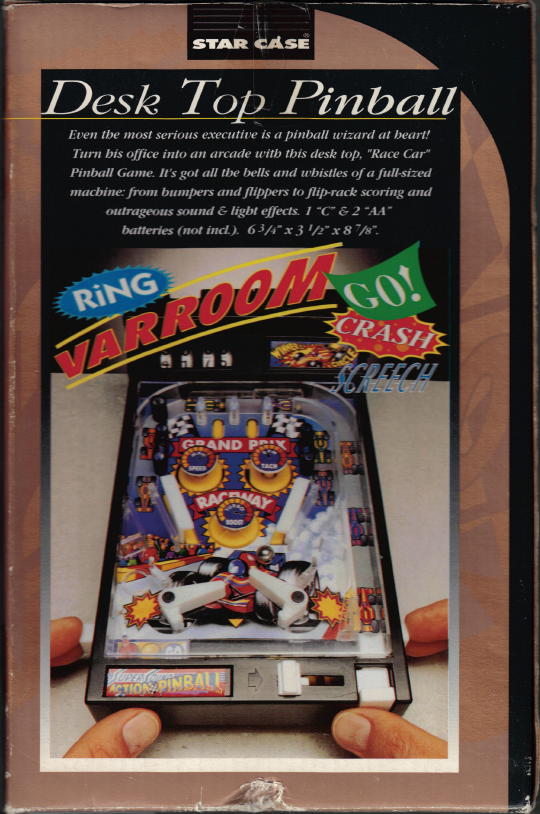
Other side of box.
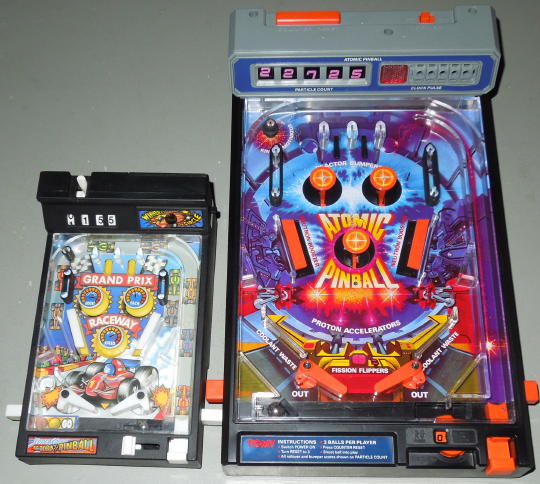
Size compared to Atomic Pinball.

An Atomic ball (left) compared to a Grand Prix ball.

Internal mechanisms.
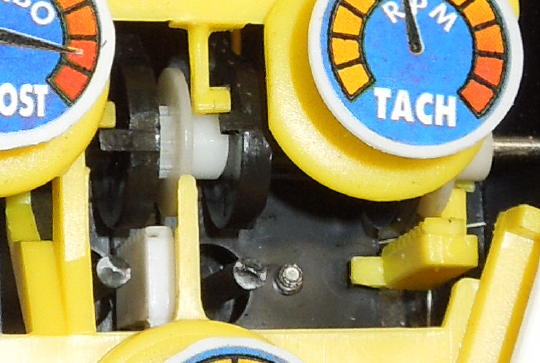
Internal mechanism detail.


Instructions for Grand Prix Raceway. Click image for larger picture.
Next up is a Galoob Hot Shot. It's smaller than Atomic Pinball and lacks the outer two rectangular bumpers. Who knows what if any connection there may be between this game and the original Tomy designs. But it's easy to see that this game may have at least been inspired by Atomic Pinball. The bumper skirts in Atomic Pinball are linked to individual mechanical triggers that activate respective individual bumpers. All the bumper skirts in Hot Shot trigger a common switch that activates the motor and spins a shaft with a cam for each bumper. Thus the motor runs only intermittently. The motor starts when the ball rolls onto a skirt and stops when one of the cam/bumper combos kicks the ball off the skirt. The top two rollover lanes also trigger the motor for scoring purposes. Scoring works much like Atomic Pinball with a separate shaft from the motor to reels in the head. I like that this game has a real bell for sound effects. Galoob Hot Shot seems to be pretty rare. So far this is the only one I've seen. Thanks to Dalibor C who grabbed the game off eBay and sent me the pictures below. --EXTERNAL LINK-- Click to see a YouTube video of Galoob Hot Shot.

Galoob Hot Shot and box.

Galoob Hot Shot. Image courtesy of Dalibor C.

Hot Shot compared to a standard Atomic Pinball. Image courtesy of Dalibor C.

Under the hood. Image courtesy of Dalibor C.

A closer shot of the bumpers and motor. Note the shaft to the right of the motor which connects with the scoring and bell mechanisms via a fourth cam. Image courtesy of Dalibor C.

The lower bumper and skirt are removed to show the motor shaft and three cams that propel the bumpers. The motor and cams spin until one of the bumpers kick the ball away from the skirts. Image courtesy of Dalibor C.
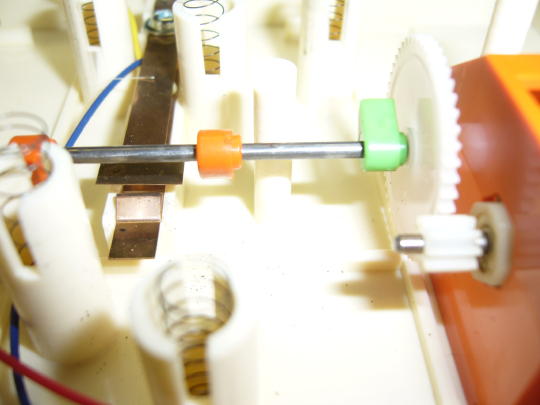
With all bumpers and skirts removed, here's a close up of the shaft and activation switch. Image courtesy of Dalibor C.
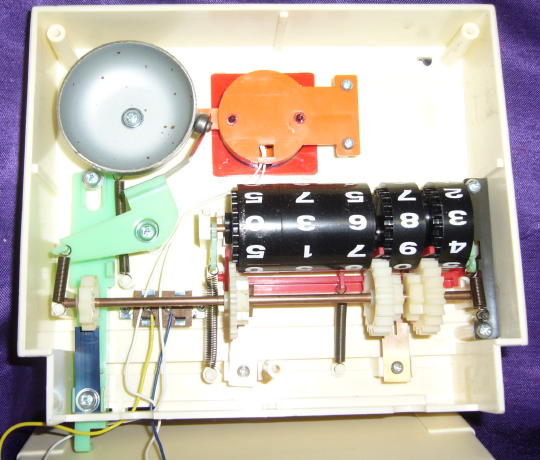
Inside the head showing the bell and score reels. Like Atomic Pinball, the three least significant digits are one reel. There's also a red light that flashes ON with the motor. Image courtesy of Dalibor C.
New for 2020 was Electronic Arcade Pinball from Ambassador Games including "vibrating bumpers" and user-applied stickers. It appears to use the basic setup from Atomic Arcade Pinball. But some of the ancillary mechanical functions have been replaced with cheesy electronics. Not sure why manufactures insist on putting their own spin on this old Tomy concept instead of simply reproducing the original game which is a proven classic.

Electronic Arcade Pinball.