
Tomy Astro Shooter Pinball
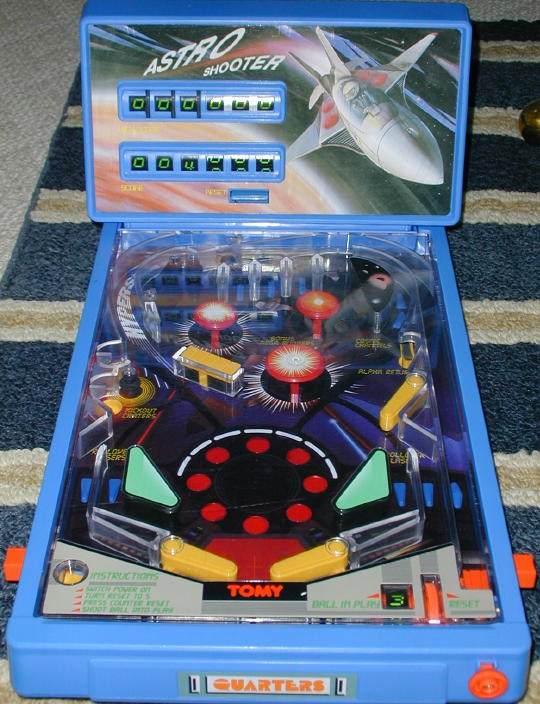
A quick note on repairs...
I don't know of anyone (including me) who repairs these games. The games are just toys and probably not meant to be serviced. This webpage exists only because I like to take stuff apart. If your game is broke you have nothing to lose by taking it apart and tinkering. But I have no advice beyond what you already see on this page. The most common problems appear to be missing power packs, missing legs and missing balls. Power pack specifications are shown below including voltage, current and polarity. Replacements should be available at Radio Shack or the like. I'd suggest taking the whole game to the store to ensure you're getting the properly dimensioned plug. The height and shape of a leg are shown below. The remaining dimensions can be ascertained from the leg sockets on the bottom of the game. Replacements could be fashioned from wood blocks or other suitable material. The balls are just 9⁄16" steel balls. Pinball parts supply businesses usually sell odd size pinballs including 9⁄16" balls. If you can't fix your game, replacement games can still be had on eBay for not much money. Good Luck!

Power pack specifications.

A leg.
Noam emailed me these files to 3D print your own replacement legs. You can download the files via the following links. Disclaimer: I know nothing about 3D printing and have in no way verified the contents of the files. Here are the links... leg.step; leg.stl.
Excessive Gear Noise
People have complained that these games are loud and noisy. Yes they are. With all those gears and other moving parts it's just the nature of what it is. I don't recommend lubrication since it's difficult to know how the different plastics may react. Plus lubricants may gum up in the long run and do more harm than good.
Kickout Craters Flaw
The middle left of the playfield has a pair of kickout saucers known as "Kickout Craters" on the original game. This mechanism has what appears to be a pretty common flaw. There's a metal input shaft with a large external gear and a small internal gear. The small gear tends to crack and spin on the shaft. A ball entering a kickout hole won't be kicked back out. If the gear is cracked, you're sort of screwed. I have two surplus Kickout Craters mechanisms and both have the same cracked gear. You might as well experiment with an adhesive. Several folks have reported success with CA. I'd recommend super thin CA. Let capillary action draw the adhesive into the gear crack and onto the shaft. For what it's worth, the gear looks to be a 10 tooth with an outer diameter of 6 mm, a thickness of 5.3 mm and a shaft diameter of 2.5 mm. The thickness dimension isn't all that critical. Take a look on the Internet and see what might be available. There's a "UXCELL 10-2.5A" gear. The outer diameter is only 5.7 mm, but maybe it's close enough.
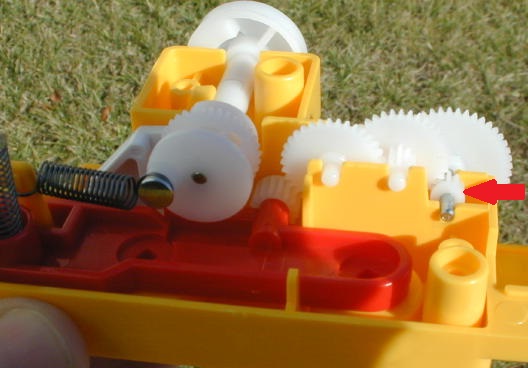
Potential gear crack (red arrow).
Update: I tried a package of those Uxcell gears and they appear to be close enough to work.
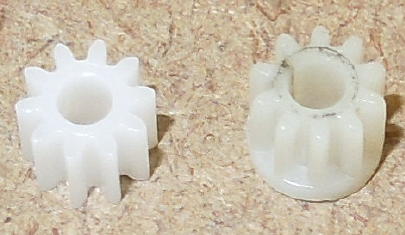
New gear (left) compared to a cracked original.
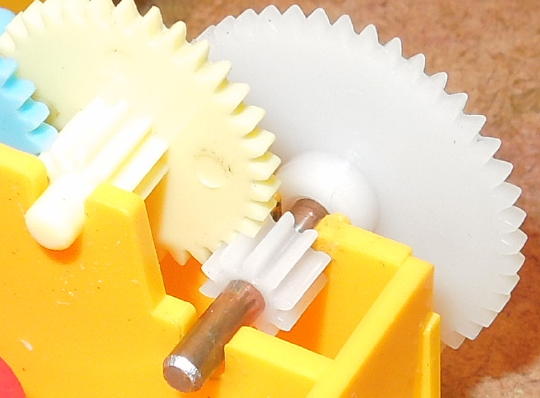
New gear installed.
Okay, now on to the game...
Tomy Astro Shooter pinball is Atomic Pinball's big brother. Astro Shooter is a bit larger and has quite a few more features. In fact, calling this game a "toy" doesn't do it justice. If you love pinball but don't have the space or money for a real machine, Astro Shooter may be a fun alternative. I believe Astro Shooter was available during the 1980s and '90s, but is no longer produced. Astro Shooter does not appear to have been as popular as Atomic Pinball, but was also twice as expensive. I got my Astro Shooter second hand off eBay. Unlike Atomic Pinball, Astro Shooter requires an AC power pack and has no provision for batteries.
Astro Shooter was produced with at least two electronic packages. The more complex version can be identified by a blinking power light in the top left corner of the playfield. Turning ON the power switch the causes the light to blink, but the motor does not start until the score reel reset button is pressed. The electronics count the number of balls and the motor automatically stops after the 5th ball is lost. The light continues to blink reminding one that the power switch is still ON. The simpler version lacks the power light. The motor runs continuously so long as the power switch is ON. The player keeps track of their balls via the reset dial by the shooter.
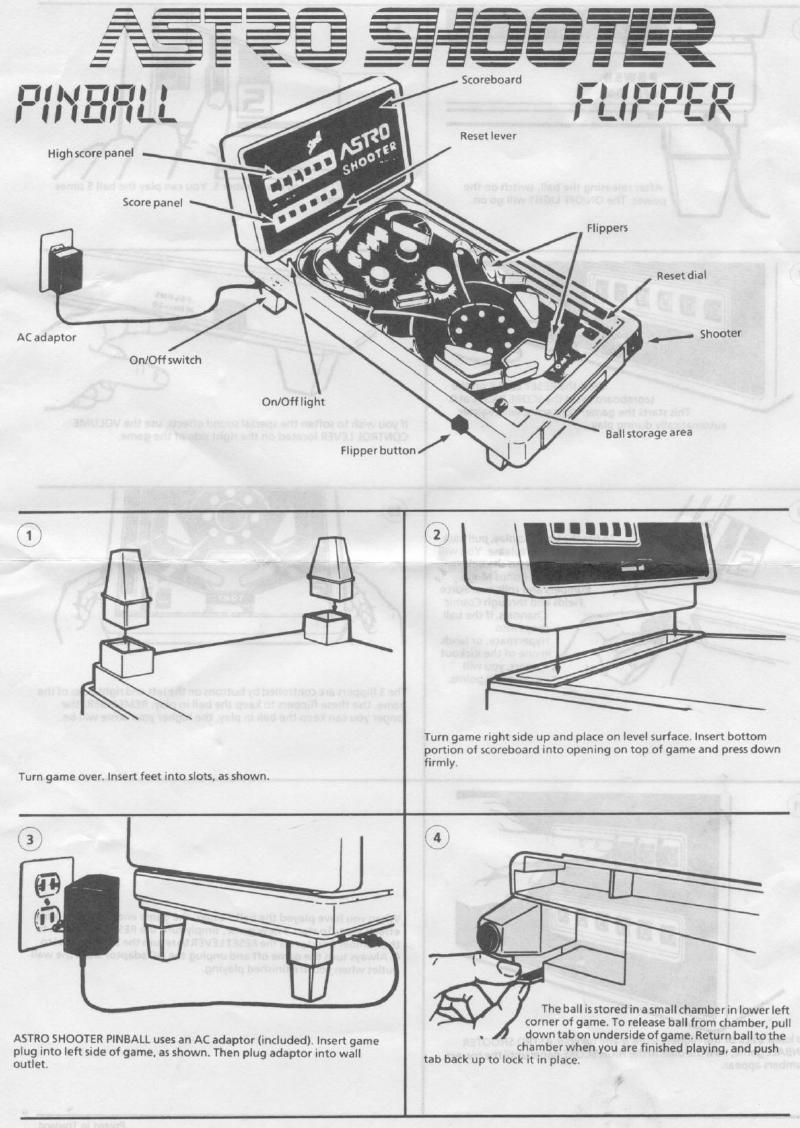
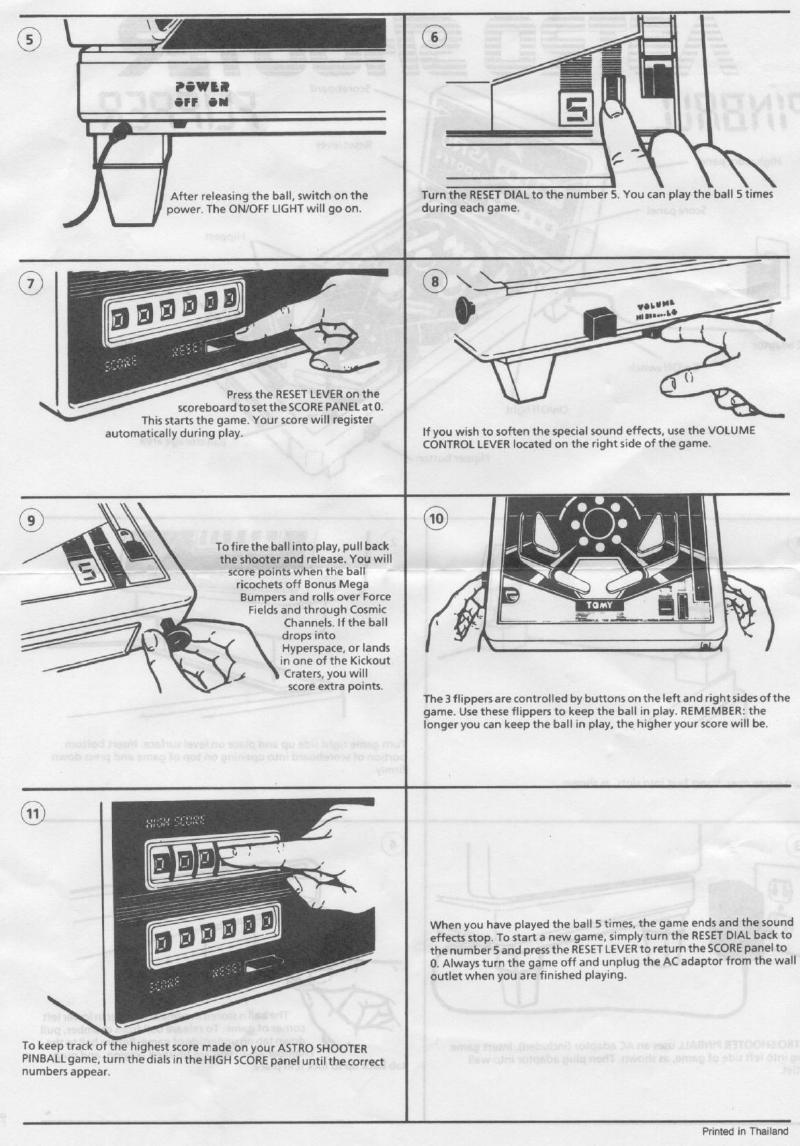
Astro Shooter instruction manual with the power light. Click for larger images.
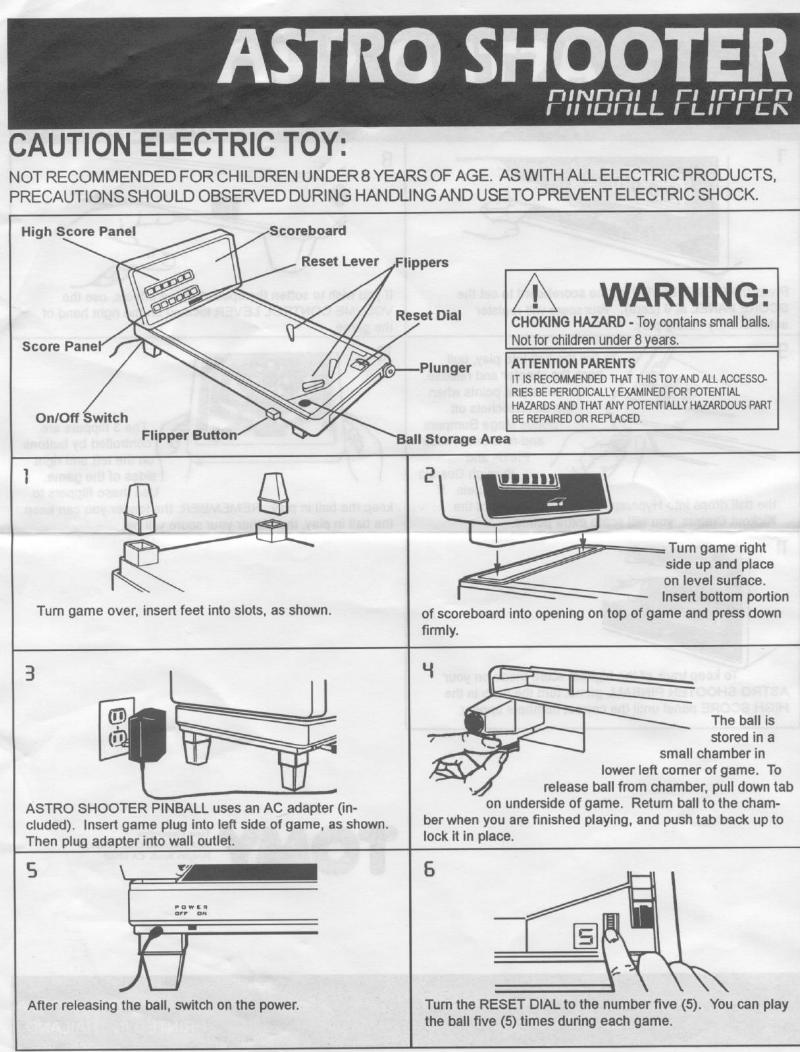
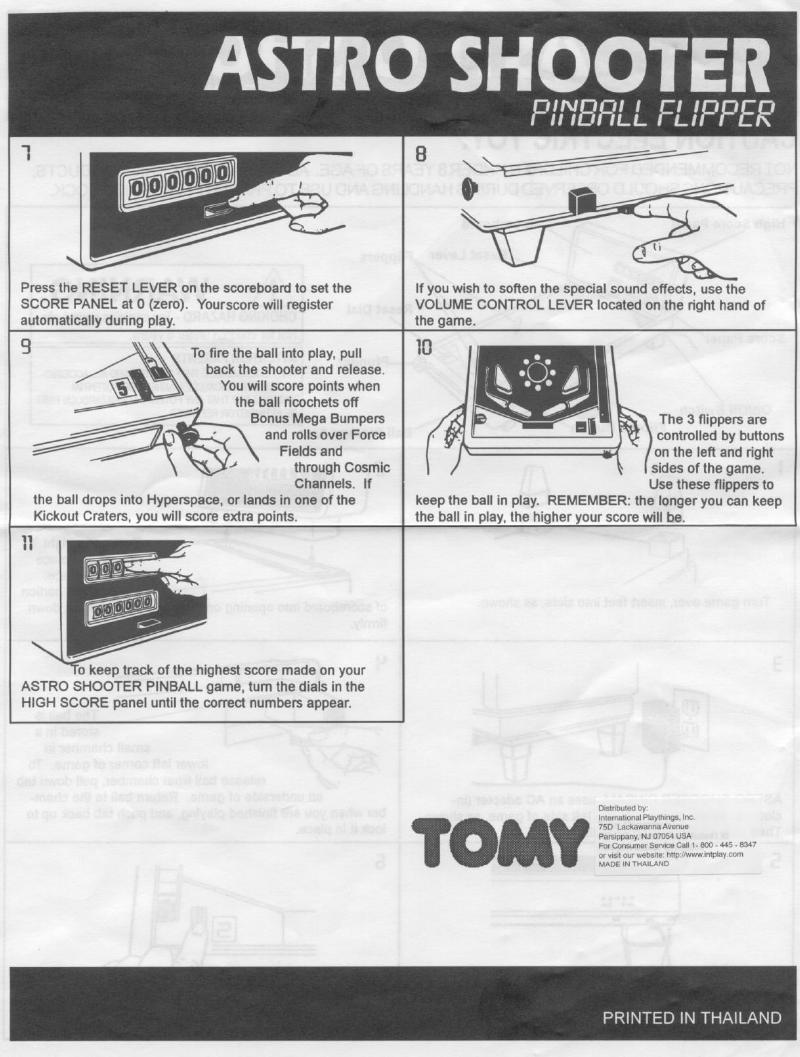
Astro Shooter instruction manual without the power light. Click for larger images.
The upper middle area of the playfield is much like Atomic Pinball with three bumpers, but only one rectangular bumper (or "slingshot" as I call it). There are three top rollovers as well as a rollover switch in the right orbit. All these components score a point when hit. At the middle left are two kick out saucers. The saucers score extra points. It's possible to shoot the ball into the lower saucer, but the upper saucer can only be hit with a random ricochet. The most lucrative shot (and most challenging) is the left orbit. At the top of the left orbit is a cellar hole. The ball disappears down the cellar hole. Many points are racked up and then the ball is shot back out above the upper right flipper. The head features two sets of score reels. The lower reels score the game while the upper reels are manually controlled to keep track of the high score to date.

Upper middle area of the playfield.
There's no scoring on the lower area of the playfield. The lower slingshots are just passive rubber bands and the inlane, outlane and shooter lane switches just trigger a sound effect. The lower area of the playfield also features a circular lighting effect. Two red lights chase each other around the circle and speed up when the cellar hole or kick out saucers are hit.
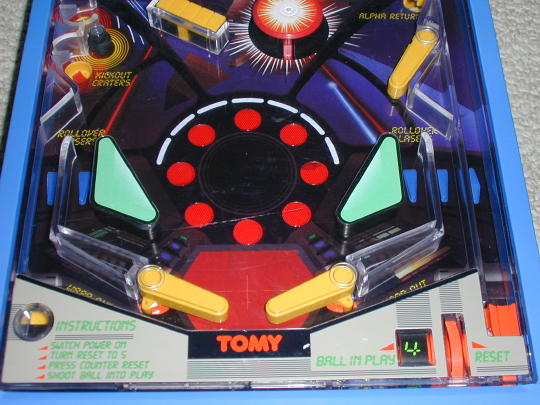
Lower area of the playfield.
Alternate Versions
Astro Shooter was produced in several art variations as well as several different themes. All the re-themed non-Astro Shooter games appear to be much more rare.
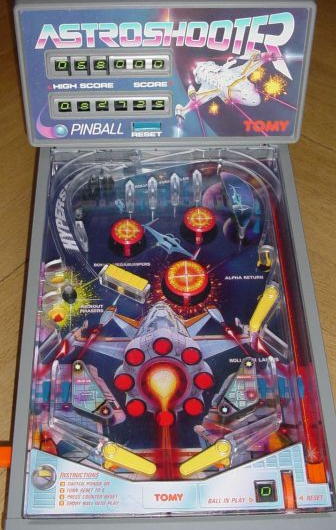
Alternate art package. Image courtesy of Jonx from Switzerland.

Yet another art package. Image courtesy of Jonx from Switzerland.
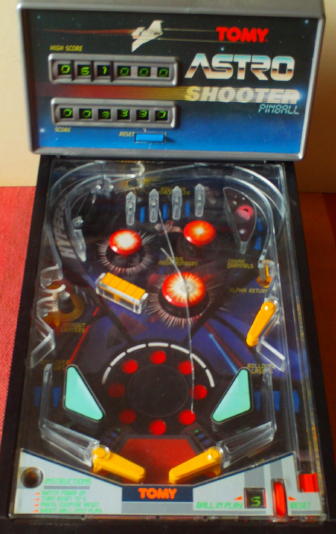
And yet another art package. Image courtesy of Jonx from Switzerland.
Below is an alternate theme called "Pirates Treasure". I've read that this version was exclusively sold by a defunct chain of stores called "The Sharper Image". I don't believe I ever heard of such a store so I can't say.
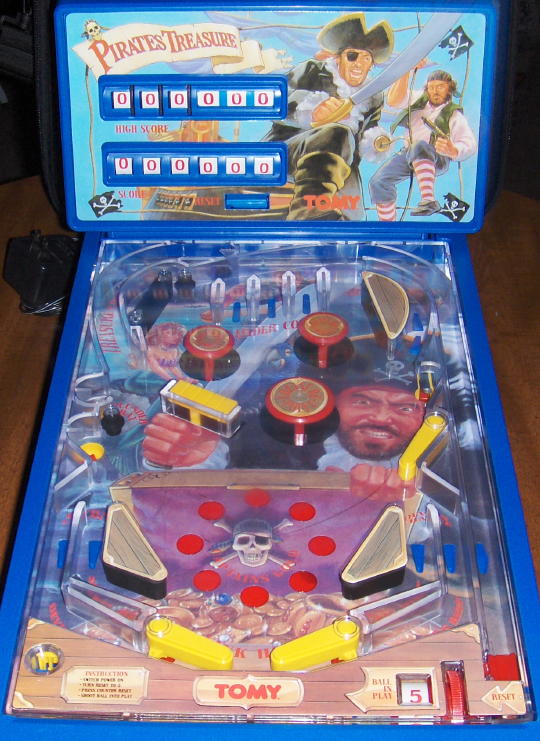
An alternate theme called "Pirates Treasure". Image courtesy of Dave Kiel.
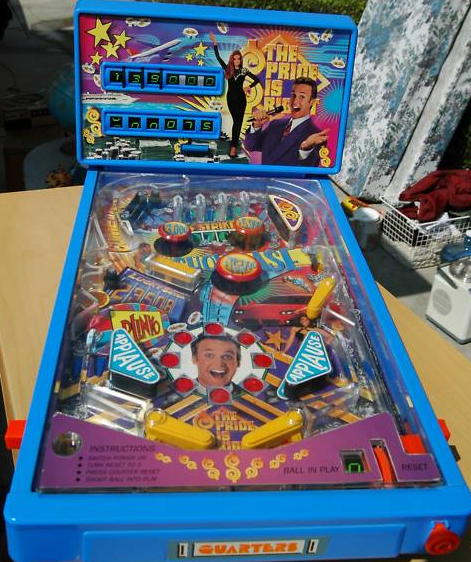
Yet another theme called "The Price is Right".
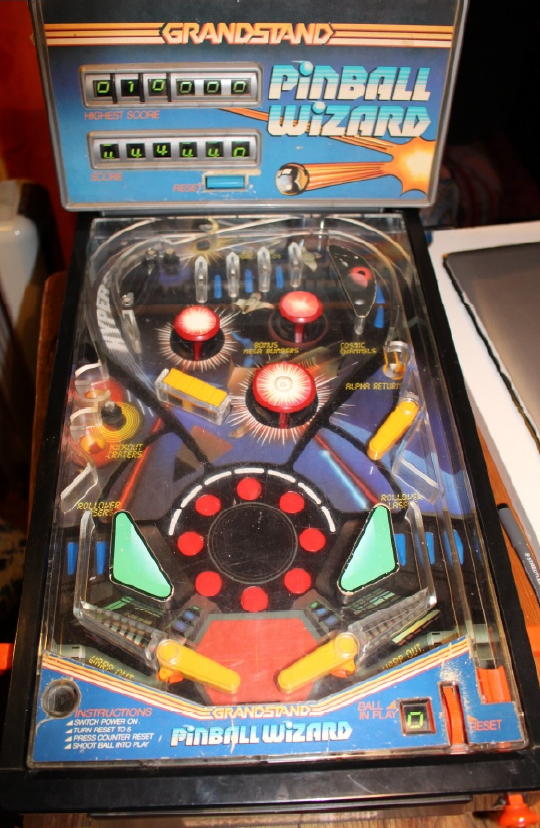
And another theme called "Grandstand Pinball Wizard". Image courtesy of Bob Clarke.
Below is The Franklin Mint's Coca-Cola Collector's Pinball (click for larger images). Apparently this item was offered in 1997. The left image is supposed to be an ad from a 1997 issue of TV Guide magazine. According to the ad this game would have been a $450 investment! It's a good looking re-theme with a completely redesigned body and head. This game still seems to go for several hundred dollars eBay. This game may require a different power pack than that shown above for Astro Shooter and American Pinball. I have no confirmation one way or the other.



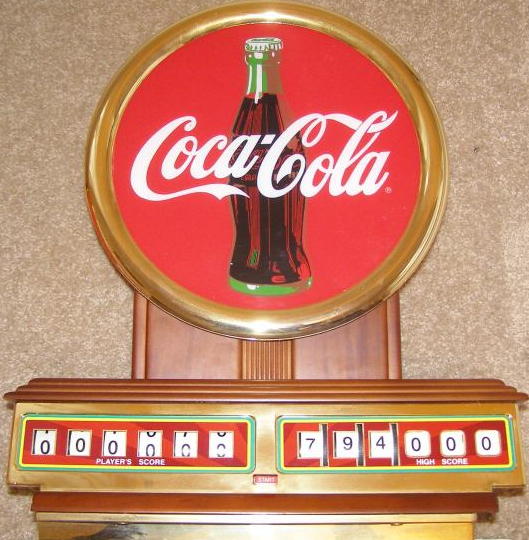
The Franklin Mint's Coca-Cola Collector's Pinball (click for larger images).
Tomy American Pinball
My favorite alternate theme is "American Pinball". Although still somewhat rare, American Pinball appears to be the most common of all the Astro Shooter re-themes. I prefer American Pinball's theme and art package so I acquired this example off eBay. This particular game has the more complex of the two electronic packages with the blinking power light.
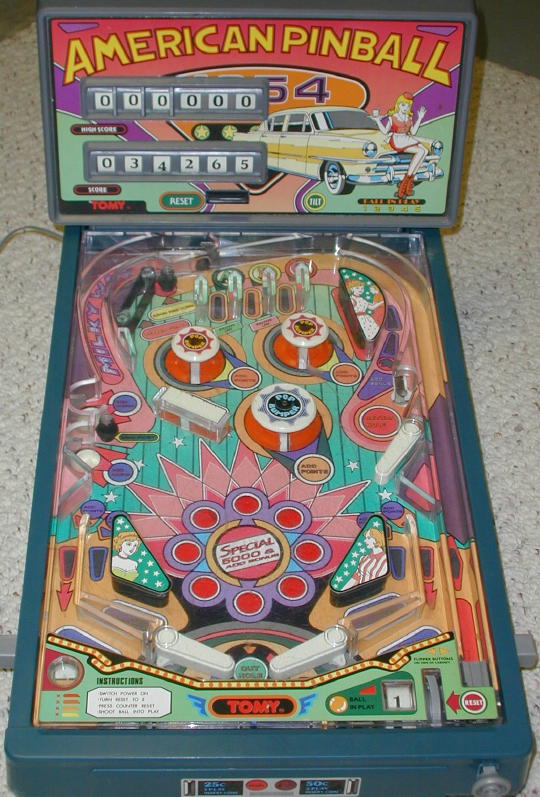
American Pinball.
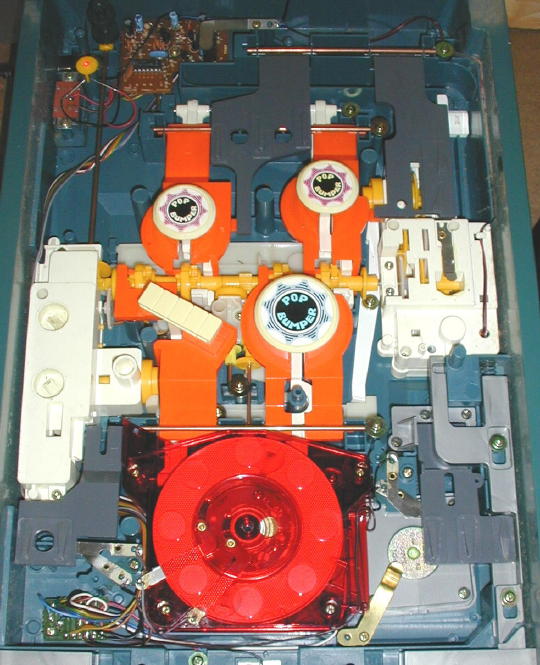
Under the hood.
The Guts
As noted above, Astro Shooter is the larger more complex big brother of Atomic Pinball. Before proceeding I suggest you read my Atomic Pinball page.
The head is designed to easily pop off for storage. Beneath the head is a plate held down to the body by three screws. After removing the plate, the "glass" comes out followed by the sheet metal playfield.
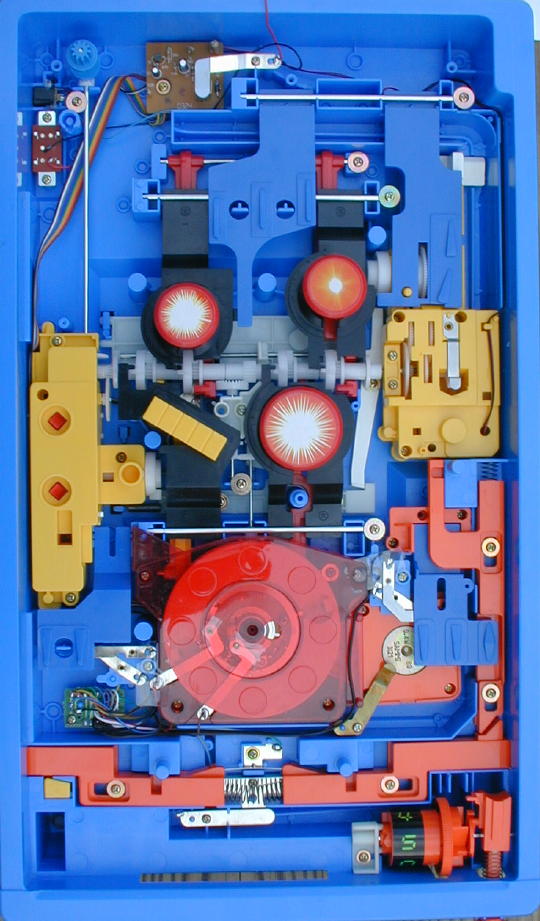
Playfield removed.
Right below that square circuit board is the beginning of the cellar hole trough. The ball rolls to the right into the white tab. The white tab triggers a mechanical delay arrangement that activates the upper right bumper for several seconds thereby racking up lots of points. After the delay the ball is lifted by the tab and continues down the trough into the yellow box where it's ejected by a toothed wheel from beneath that metal tab. The ball is ejected above the upper right flipper with enough speed that it's a challenge to catch with the flipper. Note the score shaft driving the blue gear at the upper left, which engages the score reels on the removable head. The three top rollovers trigger the left bumper. The right orbit rollover triggers the upper right bumper.

Upper mechanisms.
This shot shows how the bumpers and slingshot operate in a similar fashion as those on Atomic Pinball. The yellow box on the left is for the two kick out saucers. These operate similarly to the cellar hole mechanism, but the delay is shorter so fewer points are scored. The kick out saucers trigger the yellow slingshot.

Center mechanisms.
Here's an adjustment tip emailed from Jackson...
Hi Jeff, I recently picked up an Astro Shooter, and the large bumper barely worked. I'd come across a few YouTube videos where one table would have super-sensitive bumpers but another barely registered on direct hits. With a little experimentation, I was able to vastly improve the bumper's sensitivity by inserting slivers of card stock in the slots under the bumper skirt pivot pins and reassembling. I added the card stock under both pins of the large bumper skirt and only the outside pin of each small bumper skirt. Doing both pins of the smaller bumper skirts led to issues with the bumpers repeatedly firing when hit and the rollovers not registering. It seems that a tiny adjustment to these slots can make all the difference in how sensitive the bumpers are. I've attached a picture since it's difficult to describe. - Jackson

The upper right bumper skirt with a card stock shim under the skirt's pivot pin. Image courtesy of Jackson Wallace
Below is a close-up of the inner workings of the kick out saucer mechanism. Note that I'm holding the mechanism up-side-down. Otherwise all the gears and parts would fall out of the housing. You'll have to imagine the mechanism right-side-up as it's oriented to the rest of the game. The reduction gear train on the right engages the game's main drive shaft to supply power to the mechanism. When the ball lands into one of the kick out saucers the weight of the ball pushes down on the red arm which causes a small white gear to move down and transmit power from the reduction gear train to the shaft on the left. The cam at the far end of the shaft activates the yellow slingshot (shown in pictures above) for scoring. The cam also engages a linkage to shift the spinning light disk into high gear (see below). The spring-loaded cam on the near end of the shaft snaps the red arm back up, ejecting the ball and completing the cycle. Because of the reduction gear train's reduction, the shaft turns relatively slowly so the ball remains in the kick out saucer for a second or two while extra point are racked up. As mentioned above, the cellar hole mechanism works in a similar fashion.
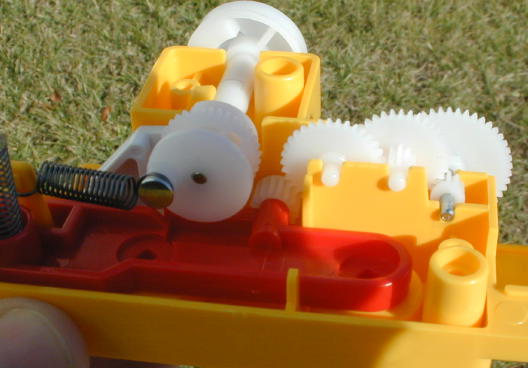
Kick out saucer mechanism.
The bottom of the body holds a spinning light disk. Note the gears right between the slingshot and bumper skirts that form a two-speed transmission for speeding up the disk when the cellar hole or kick out saucers are hit. To the right of the disk is the sound effects speaker. On the right and left are the rollover switches for the inlanes, outlanes and shooter lane. The machine has several unique sound effects for scoring, lower rollover switches, flipper action, ball drain and score reel reset.
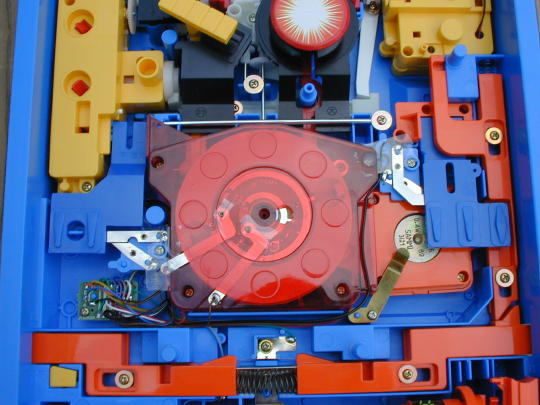
Lower Mechanisms.
Here's the spinning disk with the red lens removed. The underside of the red lens has a pair of electrical wipers that contact the circuit board on the disk. This particular picture is from my American Pinball. The lights on the spinning disk did not work. The two bulbs are connected in series so if one is burned out, neither will work. I replaced the old bulbs with a pair of miniature 6-volt lamps I found at Radio Shack. The new lamps are about the same size and include wire leads just like the originals. The repair was as simple as removing the circuit board and soldering in the new lamps. Note the small yellow drive gear near the top of the disk. The gear engages teeth on the underside of the spinning disk.
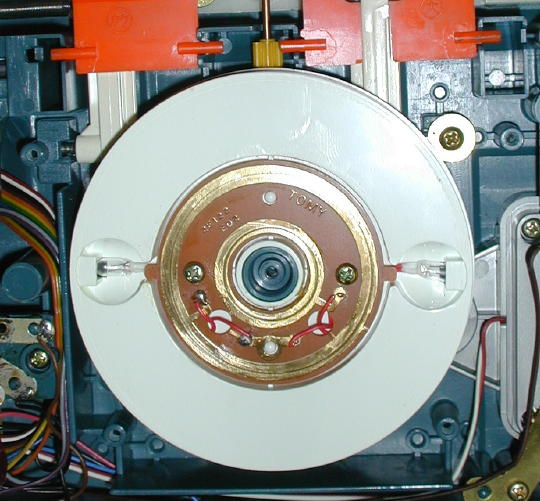
Spinning light disk.
Below is a picture of the score reels with the rear access panel removed. Like Atomic Pinball, the first three digits are one reel. So ignoring the two least significant digits, the game scores from 0000 to 9999. The blue gear here in the head meshes with the blue gear in the body shown above. The top reels are manually adjusted to record the high score to date.
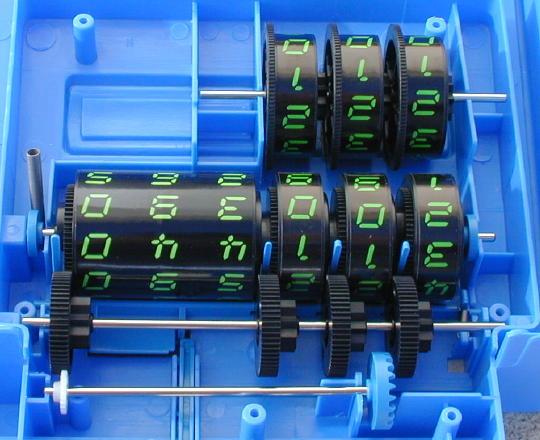
Score reels.
As noted above, Astro Shooter was produced with at least two different electronic packages. Shown below is the more complex circuit arrangement. Note the larger circuit board and the red power LED light. This version exerts control over the game as well as generating the sound effects. When the power switch is turned ON, the little red light begins to blink, but the motor does not start. To start a game, the score reel reset lever must be pressed. This closes the switch contact on top of the circuit board and tells the circuit to turn ON the motor and start a game. The circuit counts the number of balls lost. When the 5th ball is lost, the game is over and the circuit turns OFF the motor. The reset lever must again be pressed to start the next game. The light continues to blink until the power switch is turned OFF. I suppose this scheme was meant to prevent the player from "cheating" as no more than 5 balls can be played per game.
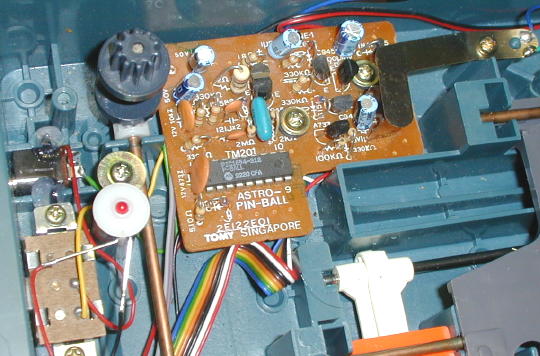
Complex circuit arrangement.
The simpler electronic package lacks the blinking red power light. The circuit board does not control the game. The board is only responsible for power distribution, sound effects and speaker amplification. The top side of the board is straight forward, easy to decipher and populated with replaceable components. The underside of the board shows what is probably a surface mount sound IC concealed under a round blob of black plastic. I don't know what kind of chip it may be or how it's connected. Obviously it's an unserviceable component.
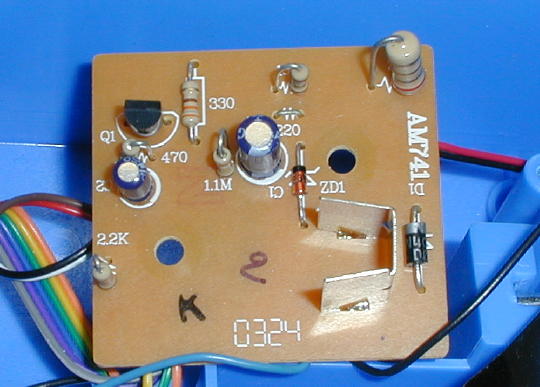
Topside of the simpler circuit board.

Underside of the simpler circuit board.
Here's a rough schematic of the circuit. Voltage from the ON/OFF switch is fed to polarity protection diode D1 and then distributed across the top to other components via a resistive divider circuit. Circuitry at left is for speaker amplification. Circuitry in the middle is a primitive power supply for the IC. Remaining connections feed switch inputs to the sound IC.
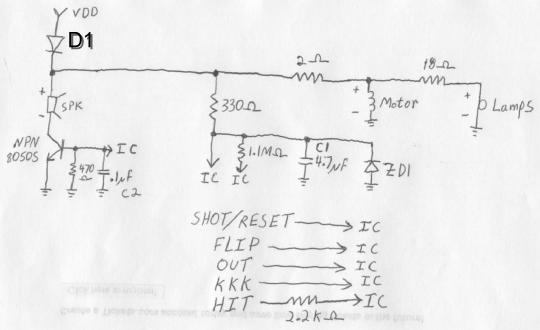
Schematic.
The down side to this simple arrangement is that the player can continue playing balls just by turning the reset dial next to the shooter. No big deal I suppose. I'm guessing this simple version is newer, the result of late production cost-cutting. The game retains space and mounting points for the larger circuit board and power light.

Empty mounting pedestal for the missing power light.
Rubber Modifications
The game's playfield includes four black rubbers that don't provide much bounce. The tiny light-weight pinball just doesn't carry enough momentum to interact well with the stock rubber. I replaced the rubbers with Scunci hair bands which are made from a much bouncier form of rubber. I used seven hair bands at each of the four positions. So it takes two packages of hair bands to outfit the game. The bouncier rubber conveys a much more realistic movement to the little pinball and the game is correspondingly more fun.
For whatever reason, this particular Scunci product seems hard to find. I found mine at a CVS Pharmacy. At rest the bands are about 1 1⁄8" in diameter and about 3⁄32" thick. They are packaged as all black or half black, half clear. I prefer all black.

Scunci hair bands.
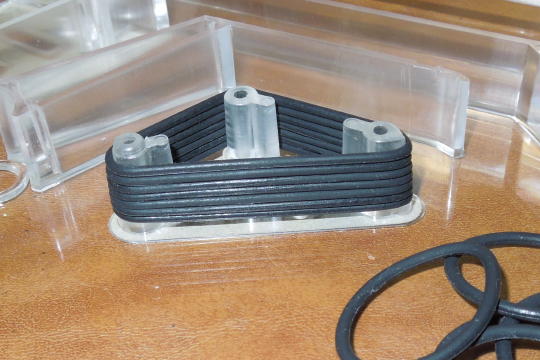
Underside view of a lower playfield rubber.
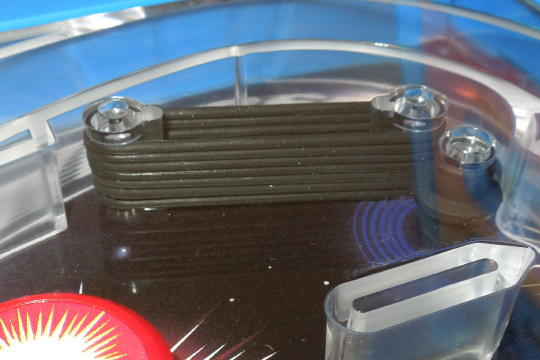
Top view of an upper playfield rubber.
Another rubber tip from TKarle... Take a bicycle inner tube with a small diameter and cut a thin slice across it making a thin rubber band for the flippers. Fits snuggly but doesn't bind against anything. Game play is greatly improved. Ball drains down the middle are reduced when just the tip of the flipper is hit. Overall better ball contact and control.

Flipper rubber made from an inner tube.
Multiball !!!
The Astro Shooter ball trough mechanisms are able to handle more than one ball. I tried two. There's no strategic advantage. It's just something different to try. You'll still get only five balls per game. It's kinda like pinball back in the manual ball-lift days.
Yet Another Version (sort of)
I tacked this to the bottom of the page because it's a significantly different game, not just another re-theme. Around 2009 Astro Shooter was "re-imagined". This time it's by Franklin Sports and called Homerun Action Pinball. Don't confuse Franklin Sports with the Franklin Mint and their Coca-Cola game shown above. Unlike all the other versions of Astro Shooter shown above, this new product appears to have been mechanically redesigned. What jumps out at me are the top two round bumpers, which appear to have been replaced with the boring passive rebound springs that so typify crappy toy pinball games. As a pinball geek I must protest. Springs suck! Accordingly, I can't see how this game would be as much fun as an original Astro Shooter. The bottom round bumper and rectangular bumper mechanisms also appear to have been redesigned. The head is completely different. Digital scoring has replaced the old mechanical scoring. Elaborate sound effects are advertised. The game has been adapted to run on 4 "D" batteries. An optional AC power pack can be purchased separately. I would guess that the new power pack outputs 6 volts. So don't try using the 9 volt pack from an original Astro Shooter.
It would appear that Franklin Sports has "cheaped out" on at least some of the mechanics that made the original Astro Shooter such a charming game. If anyone out there has played this new game, I'd be interested to hear your opinion of it.

Homerun Action Pinball. Click image for a really big picture.
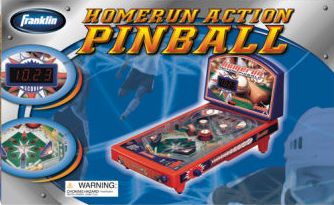
Homerun Action box art.
Here's a Homerun Action review emailed from Jackson...
Well, the Homerun Action pinball showed up today, and it plays worse than I expected. Your initial impression that this represented a significant downgrade from the previous design is confirmed. It seems that the entire design was reworked primarily to save production costs with little concern for the result. They totally redesigned the remaining bumper and kicker and the new design doesn't work remotely as well. The "tops" of the bumper and kicker now attach to the cover, because, instead of a center piece which pulls down, they now push up. The back side of the kicker is now open which could be pretty interesting if the kicker functioned better. I've tried to adjust the height of the top portion of both by spacing them off the plastic cover, but it hasn't produced any noticeable difference. I'll spend some time making adjustments to see if I can get any better action out of them, but I'm not hopeful. Pulling the plunger back no longer feeds the ball. The ball feed is now done with a dedicated slider which I assume was done to decrease mechanical complexity and assembly cost. The bottom flippers have been redesigned to make them interchangeable, reducing the part count. They've replaced the rotating-lights design with an LED array. The head contains the battery box and A/C hookup. There are 4 spring loaded contacts in the base. I'm guessing that two contacts send power to the unit and two control the score counter, since the controller board is located in the table portion. The sound package is disappointing for a 2009 redesign, since they could have added some high quality sounds pretty cheaply. The rollovers are now all contact switches, and they're probably the only redesigned parts that work well. This pinball is still better than the completely passive models, but it's a huge step down from the old design. - Jackson